VaporSpace
An infinite spatial canvas for architects and planners — powered by Nebius Token Factory, Nebius AI Cloud, and NVIDIA models.
Built With
Nebius Token Factory
Provisioning API credentials and managing authentication tokens for the VaporSpace backend service layer.
Nebius AI Cloud
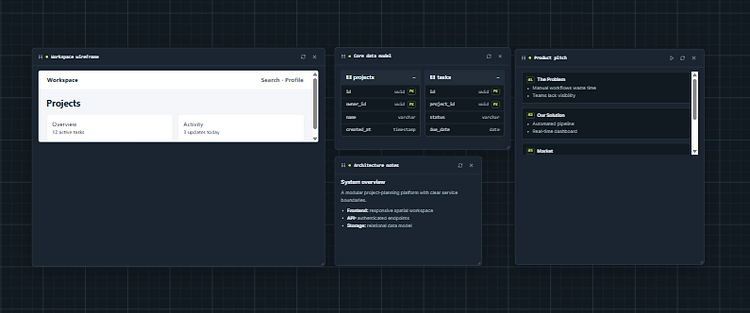
Powering the LLM-driven content generation engine — flowcharts, database schemas, landing pages, presentations, and architecture notes.
NVIDIA Model (via Nebius)
Complex reasoning for multi-type content generation — turning a single user prompt into coordinated diagrams, schemas, wireframes, and slide decks simultaneously.
Tool Feedback
Every tool we used — what worked, what didn't, and whether we'd build with it again.
Nebius Token Factory
Provisioning API credentials and managing authentication tokens for the VaporSpace backend service layer.
Straightforward token issuance flow — once authenticated, the token was immediately usable for downstream API calls with no extra configuration.
The token lifecycle management UI could be more intuitive. Auto-refresh and rotation indicators would reduce manual monitoring.
Zero to hello world took about 15 minutes. The initial setup steps were clear, though finding the right scope permissions required a doc dive.
Reliable, fast token provisioning with minimal friction. It just works once configured.
Nebius AI Cloud
Powering the LLM-driven content generation engine — flowcharts, database schemas, landing pages, presentations, and architecture notes.
Low-latency inference, structured JSON output support, and excellent uptime. The spatial canvas AI assistant relies on it for every generation request.
Rate limiting feedback could be more granular — a 429 with a retry-after header would let the UI show precise wait times instead of generic error messages.
Zero to hello world was impressively fast. The SDK integrated cleanly with our React/Vite frontend. Docs covered the common paths well.
Performance and reliability are top-tier. The structured output feature alone saved us from building a custom JSON parser layer.
NVIDIA Model (via Nebius)
Complex reasoning for multi-type content generation — turning a single user prompt into coordinated diagrams, schemas, wireframes, and slide decks simultaneously.
Strong instruction following and coherent multi-format output. The model understood spatial canvas context and produced content that fit together as a cohesive workspace.
Occasional verbosity in intermediate reasoning steps that we had to trim for UI responsiveness. Temperature tuning for creative vs. structured tasks needed manual experimentation.
Plugged into the Nebius AI Cloud endpoint — no separate SDK needed. Model selection and parameter passing were well-documented.
Quality of multi-format generation is unmatched for this use case. A single prompt producing a full workspace of diagrams and docs is the core value prop of VaporSpace.
Submission Tips
A stronger submission checklist.
Name your project like a human
VaporSpace — not "spatial-canvas-ai-v2". Memorable, meaningful, and tied to what the app actually does.
Hide your API keys
Never put API keys directly in code. Use environment variables, add .env to .gitignore, and check your repo before submitting.
Make required tools impossible to miss
Name Nebius Token Factory, AI Cloud, and your NVIDIA model in the project description, Built With section, and demo video — with audio.
Treat your video like a pitch
3 minutes: lead with the problem, show the solution working, tell judges who it's for and how it uses Nebius + NVIDIA.
Call out tools with audio
Don't just show a logo — say it out loud. "We use Nebius AI Cloud with NVIDIA models for every generation" lands harder than a passing mention.
Screenshots
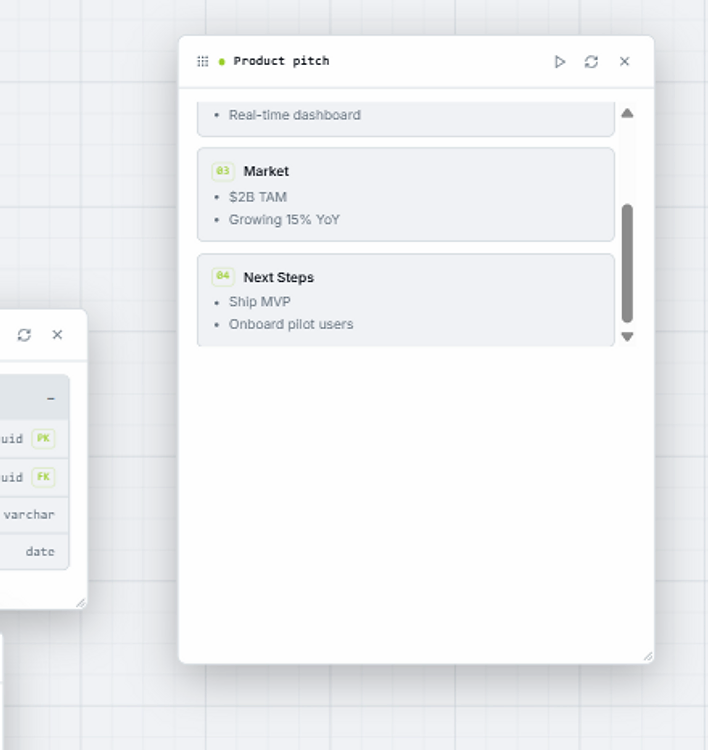
VaporSpace in action — every card below was generated from a single user prompt via Nebius AI Cloud + NVIDIA models.



Ready to explore the workspace?
Launch VaporSpace and generate your first AI-powered architecture in seconds.
Launch VaporSpaceWe use essential cookies and local storage to keep you logged in and save your canvas state. See our Cookie Policy.